ArticleRelease.com Review: A Complete Guide to Content Publishing, SEO, and Article Distribution
articlerelease
Introduction to ArticleRelease.com
ArticleRelease.com is a content-focused website that provides information about article publishing, blogging, content marketing, and strategies for improving online visibility. The platform presents itself as a resource for bloggers, writers, website owners, and digital marketers who want to reach relevant audiences through effective content distribution. In this detailed ArticleRelease.com review, we explore the website’s purpose, content strategy, potential benefits, publishing guidance, SEO considerations, and limitations. We also explain how readers can evaluate its articles, apply its recommendations, and combine content publishing with other digital marketing methods. Whether you are a beginner blogger or an experienced marketer, understanding the website’s focus can help you decide how its information fits your content strategy.
What Is ArticleRelease.com?
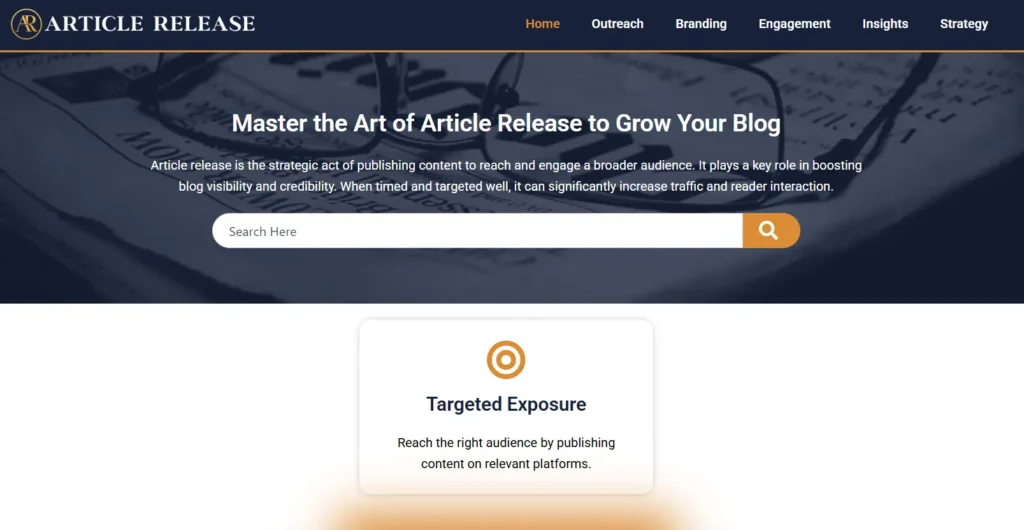
ArticleRelease.com is an online content platform focused on helping people understand how to publish, promote, and distribute articles more effectively. According to its About Us page, the website aims to help bloggers, writers, and content creators improve visibility, grow their audiences, and make their content more effective. <Cite refs={[“turn662499search2”]}/>
The central idea behind the website is that publishing an article is only one part of a successful content strategy. Even a well-written article may struggle to attract readers if it does not address a clear audience need or reach the right distribution channels.
ArticleRelease.com discusses the broader process of content planning, search optimization, article promotion, and performance tracking. These subjects can be relevant to individual bloggers, small businesses, publishers, and marketing teams that want to improve how they manage online content.
However, readers should distinguish between the website’s stated goals and independently verified outcomes. Reading publishing advice does not guarantee more traffic, higher search rankings, or additional customers. Results depend on the quality of the content, the website’s existing visibility, the competition, and how consistently recommendations are applied.
The Main Purpose of ArticleRelease.com
The website’s stated purpose is to help people make their content more visible and reach relevant readers. This involves several connected activities:
- Planning topics around audience needs.
- Creating useful and original articles.
- Optimizing content for search engines.
- Publishing articles in a clear and accessible format.
- Promoting content through relevant channels.
- Measuring traffic and engagement.
- Updating articles when information becomes outdated.
These activities form part of a broader content marketing process. Each step supports the others, but none can guarantee success independently.
For example, search optimization may help search engines understand an article, while social media distribution may introduce it to a new audience. A useful article can then encourage readers to explore related pages or return to the website.
ArticleRelease.com can be approached as an informational resource for learning about these practices.
Read More: TechGup.org Review: Content, Features, and Website Reliability
Main Topics Covered by ArticleRelease.com
The website’s public pages focus on article release strategies, content visibility, and online audience growth. Its published material discusses how writers and businesses can plan content, distribute articles, and evaluate performance. <Cite refs={[“turn662499search2″,”turn662499search3”]}/>
The following sections explain the main subjects associated with this focus and why they matter to content creators.
1. Article Publishing and Distribution
Article publishing involves more than uploading text to a website. A complete publishing process includes preparing the article, checking its quality, choosing a suitable publication date, organizing the page, and ensuring that readers can find it.
Distribution extends this process by helping the article reach its intended audience.
A publisher may share an article through a website’s blog section, an email newsletter, relevant social media channels, or appropriate industry communities. The best distribution method depends on the topic and the audience.
Why Article Distribution Matters
A website may publish valuable content but receive limited attention if few people know that the article exists.
Distribution creates additional opportunities for discovery. A newsletter can introduce an article to existing subscribers, while a relevant social post may attract new visitors.
Search engines can also help users discover content when pages are accessible, useful, and relevant to their searches.
However, distribution should not be confused with guaranteed traffic. The audience may not respond to every article, and some channels are more suitable for particular topics than others.
Choosing the Right Distribution Channels
Before promoting an article, consider where its intended readers are likely to spend time.
For example:
- A professional business article may suit a professional networking platform.
- A visual tutorial may work well on a channel that supports images and short videos.
- An in-depth guide may be useful in an email newsletter.
- A technical resource may attract attention within a relevant professional community.
- An informational article may attract long-term visitors through organic search.
Promotional messages should be adapted to each channel rather than copied identically everywhere. More importantly, promotion should respect community rules and avoid unsolicited or repetitive posting.
2. Blogging and Content Planning
Blogging is an important part of many websites’ marketing strategies. Businesses use blog articles to explain products, answer customer questions, demonstrate knowledge, and attract visitors who are researching a subject.
ArticleRelease.com’s focus on content visibility makes planning and organizing blog content especially relevant to its audience.
Understanding the Target Audience
Effective content planning starts with understanding the people an article is intended to help.
A blogger should consider:
- What questions do readers ask?
- What problems are they trying to solve?
- How much background knowledge do they have?
- What information would help them take the next step?
- Which details would make the article more useful than competing pages?
These questions help writers avoid creating content simply to fill a publishing calendar.
For instance, a beginner searching for SEO information may need a straightforward explanation of keywords, titles, internal links, and search intent. An experienced marketer may instead want a more detailed discussion of technical SEO, content performance, or conversion tracking.
The two audiences require different approaches, even when the subject is similar.
Creating a Content Calendar
A content calendar helps writers and marketing teams organize topics, deadlines, publishing dates, and updates.
A simple calendar can include the following fields:
| Field | Purpose |
| Topic | Identifies the subject of the article |
| Target audience | Defines the intended reader |
| Primary keyword | Records the main search phrase |
| Search intent | Describes what the reader wants to accomplish |
| Writer | Identifies the person responsible for the draft |
| Publication date | Sets the planned release date |
| Internal links | Lists relevant pages to connect |
| Update date | Tracks when the content should be reviewed |
A calendar should be flexible. If new information becomes important or a topic loses relevance, the publishing plan may need to change.
Consistency can help teams maintain an organized workflow, but publishing frequently is not a substitute for quality.
3. Search Engine Optimization for Articles
Search engine optimization, commonly known as SEO, helps search engines understand a page and helps users determine whether it answers their questions.
ArticleRelease.com’s subject matter is closely related to the practical work of making articles discoverable online.
Keyword Research
Keyword research identifies the words and phrases people use when searching for information.
Writers should consider both the topic and the reason behind a search. Someone searching for “how to publish a blog post” probably wants instructions, while someone searching for “content marketing tools” may be comparing available solutions.
Useful keyword research considers:
- The subject’s relevance to the website.
- The reader’s likely search intent.
- Related questions and subtopics.
- The competition in search results.
- The level of detail needed to answer the query.
A primary keyword should be included naturally in important page elements when relevant. It should not be repeated excessively simply to increase keyword frequency.
Writing SEO-Friendly Titles
A page title helps readers and search engines understand the subject of an article.
An effective title is descriptive, relevant, and easy to understand. It should communicate the main value of the page without making promises that the content cannot support.
For example, a guide about content distribution might use a title such as “How to Distribute Blog Articles and Reach Relevant Readers.”
Titles should accurately represent the content. Misleading headlines may attract clicks initially but can disappoint readers and damage trust.
Meta Descriptions
A meta description summarizes a page’s subject and may be used by search engines when generating a search result snippet.
A useful description should explain what the reader will learn and include the primary topic naturally. Search engines may choose different text from the page, so a written description does not guarantee that the exact wording will appear in search results.
Heading Structure
Headings help readers scan an article and understand how its ideas are organized.
A typical structure uses one clear H1 for the main title, H2 headings for major sections, and H3 headings for supporting topics.
For example:
- H1: A Complete Guide to Article Distribution
- H2: Why Article Distribution Matters
- H3: Choosing the Right Channels
- H2: Measuring Content Performance
- H3: Tracking Referral Traffic
Headings should reflect the actual content beneath them. Adding keywords to every heading can make an article repetitive and difficult to read.
Internal Linking
Internal links connect one page on a website to another page on the same website.
They help readers discover related content and provide search engines with additional context about the site’s structure.
For example, an article about content distribution could link to another guide about keyword research or writing effective headlines.
Internal links should be relevant and useful. Linking every paragraph to the same page or using identical keyword-rich anchor text repeatedly may make the content feel unnatural.
Technical Accessibility
Search optimization also depends on technical factors.
Important checks include whether pages can be crawled, whether the intended pages are indexable, whether canonical tags are appropriate, whether mobile layouts work properly, and whether pages load reliably.
A well-written article may struggle to appear in search results if important technical problems prevent search engines from accessing or indexing it.
These issues may require assistance from a developer or SEO specialist, depending on the website’s setup.
For official guidance, publishers can consult Google Search Central, which explains foundational SEO practices.
4. Content Quality and Originality
Content quality is central to any publishing strategy. Articles should help readers understand a subject, answer meaningful questions, or complete a task.
Simply producing a large volume of pages does not ensure that a website will attract a loyal audience.
What Makes an Article Useful?
A useful article generally has a clear purpose, logical structure, accurate information, and an appropriate level of detail.
It may also include practical examples, relevant evidence, helpful illustrations, or links to authoritative sources.
Writers should ask whether the article resolves the reader’s main question. If important details are missing, additional research may be more valuable than adding unnecessary words.
Originality and Added Value
Original content does not mean that every idea must be completely new. Many useful articles explain established concepts.
The key is to provide value through clear explanations, relevant examples, thoughtful analysis, or a more effective organization of information.
Rewriting another page sentence by sentence without adding useful information does little to help readers.
Publishers should also avoid copying content without permission and should respect copyright requirements.
Fact-Checking
Writers should verify important factual claims before publication.
The verification process may include checking official documentation, consulting primary sources, comparing reputable references, and reviewing publication dates.
Fact-checking is especially important for topics involving financial decisions, health, law, cybersecurity, product specifications, and current developments.
An article can be easy to read while still containing errors. Readability and factual accuracy should be treated as separate quality checks.
Updating Existing Content
Content can become outdated as products, policies, tools, and industry practices change.
A regular review process helps publishers identify old statistics, broken links, outdated screenshots, and recommendations that no longer apply.
Updating an article should involve meaningful improvements rather than changing the date without reviewing the information.
5. Content Marketing and Brand Visibility
Content marketing uses useful information to attract and maintain the interest of a defined audience.
Blog posts, tutorials, case studies, newsletters, and educational resources can all contribute to a content marketing strategy.
ArticleRelease.com’s focus on visibility and audience development makes this subject relevant to readers who want to connect content production with broader business objectives.
Building Recognition Through Useful Content
A business can use articles to explain its industry, answer common customer questions, and demonstrate its knowledge of a subject.
Over time, a consistent collection of relevant articles can give visitors more opportunities to understand the business and explore its offerings.
However, brand recognition develops through multiple interactions. A single article does not automatically create trust or establish authority.
Matching Content to Customer Needs
Different readers may need different information at different stages of their decision-making process.
Someone learning about a problem may need an introductory guide. A person comparing solutions may need a detailed comparison. Someone already interested in a service may want pricing, implementation information, or answers to common objections.
A content plan should reflect these differences rather than treating every article as a direct sales pitch.
Read More: UpdateArticle.com Review:
Measuring Business Outcomes
Content marketing can support business goals, but performance should be measured according to the purpose of each page.
A guide designed to attract organic traffic may be evaluated differently from a page intended to generate inquiries.
Possible measures include relevant website visits, newsletter subscriptions, qualified leads, engagement, and conversions.
The most useful metrics are those connected to a clear objective.
6. Social Media Promotion and Article Distribution
Social media can help publishers introduce their content to audiences beyond their existing website visitors.
The value of a social platform depends on the subject, the audience, and how the content is presented.
Create Platform-Specific Promotions
Instead of sharing only a bare link, publishers can highlight a key lesson from an article, ask a relevant question, or create a short summary.
A professional audience may appreciate an industry insight, while a general audience may prefer a practical tip or an easy-to-follow visual.
The promotional message should provide enough context for people to understand why the article is relevant.
Avoid Spam-Like Promotion
Posting identical links repeatedly in unrelated communities can irritate users and violate platform rules.
Publishers should choose relevant channels, follow community guidelines, and participate in discussions where their content genuinely adds value.
Promotion should focus on helping people discover useful information, not simply increasing the number of links posted.
Combine Social and Search Traffic
Social media and organic search can serve different purposes.
Social platforms may provide initial attention, particularly when an article addresses a timely subject. Organic search can help users discover relevant information over a longer period.
Neither channel guarantees consistent results. A balanced strategy reduces dependence on a single source of visitors.
7. Email Marketing and Subscriber Engagement
Email marketing allows publishers to communicate with people who have chosen to receive updates.
For bloggers and businesses, email can provide a direct way to share new articles, useful resources, and relevant announcements.
Creating a Useful Newsletter
A newsletter does not need to reproduce an entire article. It can introduce the topic, summarize a useful point, and link to the full page.
The message should make its value clear and avoid overwhelming subscribers with unnecessary promotions.
Publishers should also use appropriate consent practices, provide a clear unsubscribe option, and comply with applicable privacy and marketing laws.
Measuring Email Performance
Email metrics may include delivery, clicks, unsubscribes, and conversions. These measurements can help publishers understand whether their messages are reaching and engaging the intended audience.
Open rates can be affected by email privacy features and tracking limitations, so they should not be treated as a complete measure of reader interest.
Respecting Subscribers
A good email strategy is built around relevance and trust.
Publishers should send messages that match the expectations established when people subscribed. They should also protect subscriber information and avoid adding people to mailing lists without an appropriate basis.
8. Backlinks and Off-Page SEO
Backlinks are links from other websites pointing to a page on your website. They can help users discover resources and provide search engines with context about how pages are referenced across the web.
However, acquiring links should not be treated as a guaranteed shortcut to higher rankings.
Why Relevant Backlinks Matter
A link can be useful when it introduces readers to genuinely relevant information.
For example, a detailed guide about publishing research might be referenced by a relevant educational resource, professional publication, or industry blog.
The value of such a link depends on context, relevance, and the credibility of the source. A large number of unrelated links does not necessarily indicate a strong website.
Earn Links Through Useful Resources
Publishers can improve their chances of attracting references by creating material that others have a reason to cite.
Examples include:
- Original research or surveys.
- Comprehensive educational guides.
- Useful tools and templates.
- Clearly documented case studies.
- Helpful explanations of complex topics.
- Data visualizations based on reliable information.
These resources provide a meaningful reason for another publisher to link to the content.
Avoid Manipulative Link Practices
Buying links intended to manipulate search rankings, participating in link schemes, or publishing large volumes of low-value guest posts can create SEO risks.
Guest posting may be useful when the article genuinely serves the host site’s audience. The primary objective should be relevance, quality, and reader value rather than obtaining a followed backlink at any cost.
Publishers should review Google’s current spam policies before implementing a link-building strategy.
9. Measuring Content Performance
Publishing an article is not the end of the process. Reviewing performance helps writers and marketers understand whether the content is reaching the intended audience and meeting its objectives.
Organic Search Performance
Search Console can provide information about search impressions, clicks, click-through rates, and average search positions.
These metrics help publishers identify pages that appear in search results and queries that generate visibility.
A page with many impressions but a low click-through rate may benefit from a clearer title or a better match between the search result and the user’s intent. However, the correct response depends on the query and the search results being compared.
Website Engagement
Analytics tools can help publishers understand how visitors interact with their pages.
Depending on the setup, useful measurements may include landing pages, referral sources, engaged sessions, and conversions.
A high visit count does not necessarily mean an article is successful. The results should be interpreted in relation to the page’s purpose.
Improving Underperforming Articles
When a page receives limited attention, publishers can investigate several possible causes.
The topic may have limited demand. The article may not fully answer the searcher’s question. The page may be difficult to navigate, technically inaccessible, or poorly connected to the rest of the site.
A structured review helps identify the most likely issue before changes are made.
Continuous Improvement
Content optimization should be an ongoing process.
Publishers can review performance, improve weak sections, add relevant internal links, update outdated facts, and clarify the article’s purpose.
Changes should be evaluated over an appropriate period rather than assuming that every edit will immediately improve rankings.
Read More: TechDishoom.com Review: A Complete Guide to Its Content, Features, Categories, and Reader Experience
Benefits of Exploring ArticleRelease.com
ArticleRelease.com focuses on content publishing and online visibility, making its subject matter potentially relevant to bloggers, content creators, and digital marketers. The following benefits describe how this type of resource may help readers; they are not guarantees of specific results.
A Focus on the Publishing Process
The website’s stated emphasis goes beyond writing alone and includes content planning, distribution, and performance. This broader perspective can help readers think about the complete publishing workflow.
Useful Topics for Content Creators
People who manage blogs or business websites often need to balance research, writing, optimization, publication, and promotion. Information about these activities can help them organize their work.
Relevance to Digital Marketing
Article distribution overlaps with SEO, social media, email marketing, and brand development. Readers exploring these subjects may use the website as a starting point for understanding how the activities fit together.
Support for Structured Planning
A clear publishing process can reduce missed deadlines and inconsistent execution. Content calendars, review checklists, and performance reports are practical tools that teams can use alongside general guidance.
Opportunities for Further Research
Introductory articles can help readers identify questions they need to investigate in greater depth. They may then consult official documentation, specialist publications, or professional resources for more detailed answers.
Limitations to Consider When Using ArticleRelease.com
A balanced assessment should also recognize that general publishing advice has limitations.
Results Are Not Guaranteed
ArticleRelease.com’s disclaimer states that the website cannot guarantee specific outcomes and that content success depends on factors including quality, consistency, niche, and competition. <Cite refs={[“turn662499search0”]}/>
This is an important distinction. Publishing an article does not automatically lead to traffic, backlinks, higher rankings, or business growth.
Recommendations Need Context
An SEO tactic that works for one site may not be suitable for another. The correct approach depends on the website’s audience, resources, technical setup, subject matter, and existing performance.
Readers should adapt recommendations rather than applying every suggestion without evaluation.
Some Topics Require Specialized Expertise
General publishing guidance may not be sufficient for complex technical SEO issues, legal questions, privacy compliance, or advanced analytics.
In these situations, readers may need official documentation or help from a qualified professional.
Information Can Become Outdated
Search engine systems, platform policies, software tools, and marketing practices change over time.
Readers should check publication dates and verify important recommendations before implementing them.
Individual Articles Should Be Evaluated Separately
A website’s overall purpose does not establish the accuracy or depth of every article it publishes. Readers should examine the evidence, clarity, and relevance of each page.
Who May Benefit From ArticleRelease.com?
The website’s stated focus may be relevant to several audiences.
Bloggers and Independent Writers
Bloggers can explore approaches to topic planning, article organization, promotion, and content performance. These ideas may help them create a more structured workflow.
Small Business Owners
Small businesses often use content to explain their services, answer customer questions, and build online visibility. Publishing guidance may help owners plan content around customer needs.
SEO Professionals
SEO professionals may find general discussions about content optimization and distribution useful as supplementary reading. More technical decisions should be supported by current documentation, analytics, and evidence from the website being optimized.
Content Marketing Teams
Teams responsible for planning and publishing articles may use publishing frameworks to coordinate writers, editors, designers, and marketing staff.
New Website Owners
People launching a website may benefit from learning the basics of content planning and distribution before investing in more complex marketing activities.
For all these audiences, the usefulness of a particular article depends on its accuracy, practical detail, and fit with the reader’s objectives.
How to Use ArticleRelease.com Effectively
Readers can get more value from publishing advice by applying it systematically.
Define a Clear Objective
Start by identifying what you want an article to accomplish. Your objective may be to answer a customer question, attract relevant organic traffic, explain a service, or encourage readers to explore a related resource.
A clear objective helps determine the topic, format, distribution channels, and performance measures.
Research the Audience and Search Intent
Identify the questions readers are asking and what kind of answer they expect.
Review relevant search results, examine competing articles, and identify information gaps that your page can address.
Avoid selecting a topic solely because a keyword has a high search volume. Relevance to the audience matters too.
Create an Article Brief
Before writing, outline the main question, target reader, primary keyword, supporting topics, sources, and intended action.
A brief gives writers a shared understanding of the page’s purpose and reduces the risk of producing repetitive or unfocused content.
Review Before Publishing
Check the article’s accuracy, originality, spelling, structure, links, and formatting.
Confirm that the title matches the content and that readers can navigate the page easily on mobile and desktop devices.
Promote Through Relevant Channels
Choose distribution channels that suit the topic and intended audience. Use social posts, newsletters, and community participation where appropriate.
Avoid aggressive promotion in unrelated spaces.
Measure and Improve
After publication, monitor relevant performance metrics and review whether the article meets its objective.
If the results are weaker than expected, investigate the likely causes before making changes.
ArticleRelease.com and Other Content Resources
ArticleRelease.com is focused on article release strategies and content visibility. Other online resources may be more suitable for specific parts of the publishing process.
Official SEO Documentation
For questions about search engine crawling, indexing, structured data, and SEO fundamentals, official search documentation can provide a more authoritative reference.
Google Search Central is a useful starting point for understanding how Google discovers and interprets pages.
Analytics Documentation
When evaluating traffic or user behavior, consult the official documentation for the analytics tools used on your website.
This helps ensure that metrics are configured correctly and interpreted according to their definitions.
Industry Publications
Specialist marketing and publishing publications can provide examples, commentary, and analysis of current practices. Compare their recommendations with official guidance and evidence from your own site.
Professional Advice
Complex problems involving migrations, technical SEO, analytics configuration, privacy compliance, or legal requirements may require professional assistance.
Using multiple suitable resources helps readers avoid relying on one general website for every publishing decision.
Frequently Asked Questions About ArticleRelease.com
1. What is ArticleRelease.com?
ArticleRelease.com is a content-focused website that describes its purpose as helping bloggers, writers, and content creators improve content visibility and audience reach. Its subject matter includes article publishing, content distribution, and online growth strategies.
2. What is the main purpose of ArticleRelease.com?
The website aims to provide guidance on making content more visible and effective. Its About Us page discusses content planning, optimization, distribution, and performance tracking.
3. Who can use ArticleRelease.com?
Bloggers, writers, digital marketers, website owners, and businesses interested in publishing and promoting online content may find its subject matter relevant.
4. Does ArticleRelease.com guarantee higher rankings?
No. The website’s disclaimer says that it does not guarantee specific results. Search rankings depend on many factors, including content quality, competition, technical accessibility, and relevance to users’ queries.
5. Can ArticleRelease.com help beginners understand content marketing?
Its publishing and visibility focus may provide a starting point for beginners. Readers should also consult current official documentation and specialist resources when they need detailed instructions.
6. Why is article distribution important?
Distribution creates opportunities for relevant readers to discover published content through channels such as search, email, social media, and appropriate communities. It does not guarantee that people will visit or engage with an article.
7. How does SEO support article publishing?
SEO helps search engines understand content and helps users discover relevant pages. Useful practices include clear titles, logical headings, relevant internal links, technically accessible pages, and content that answers the intended search query.
8. Are backlinks important for content marketing?
Relevant backlinks can help users discover resources and provide context about how other websites reference a page. Link quality and context matter more than simply accumulating large numbers of links.
9. How can I measure article performance?
Depending on the goal, useful metrics may include organic search clicks, impressions, referral visits, engagement, newsletter clicks, leads, and conversions. The correct measurements depend on the article’s purpose.
10. Is the information on ArticleRelease.com always current?
Readers should check publication dates and verify time-sensitive recommendations. SEO practices, platform policies, and marketing tools can change, so important details should be confirmed through current sources.
11. Should I follow every recommendation I read online?
No. Evaluate whether the advice fits your website, audience, technical setup, and objectives. Test changes where appropriate and use reliable evidence to determine whether they are helping.
12. Where can I learn more about SEO?
Google Search Central provides official guidance on SEO fundamentals, crawling, indexing, and other search-related topics. Specialist resources and professional advice may also help with more advanced questions.
Final Verdict: Is ArticleRelease.com Worth Exploring?
ArticleRelease.com is an informational resource focused on article publishing, content distribution, and strategies for improving online visibility. Its stated audience includes bloggers, writers, content creators, and people interested in developing their online presence.
The website’s main subject is relevant because successful publishing involves more than writing and uploading an article. Planning, search optimization, audience research, promotion, and performance measurement all contribute to a more complete content strategy.
Readers may use the website to explore these subjects and identify practical steps for their own publishing workflows. However, its guidance should be treated as a starting point rather than a guarantee of specific SEO or business results. Important recommendations should be verified, adapted to the situation, and evaluated through evidence.
If you want to explore the website’s available resources, visit the official ArticleRelease.com homepage. Review its articles to identify subjects relevant to your work, then consult appropriate official documentation or specialist sources when you need more detailed information.
In conclusion, ArticleRelease.com focuses on helping content creators think beyond publication and consider the wider process of content visibility and audience development. It may be a useful starting point for learning about article distribution and publishing strategy, provided readers evaluate individual recommendations carefully and apply them according to their own goals.